In this article
- The question that decides whether it was worth doing
- Two setups, both called server-side tracking
- What genuinely changes
- The events that were being dropped now arrive
- The conversion arrives with better identifiers attached
- The optimization signal improves, not just the report
- What server-side tracking does not change
- Is server-side tracking legal?
- It does not defeat ad blockers as a category
- It cannot link a journey with no shared identifier
- It does not make your platforms agree with each other
- What is the difference between client-side and server-side tracking?
- Which server-side tracking setup is best for you?
- What is server-side tracking in Google Tag Manager?
- What it actually recovers, in one month
- The failure that quietly doubles your numbers
- Four checks to tell which setup you have
- What it costs to run
- How TrueTracked does this
- Where this leaves you
- Sources
You are being quoted for a server-side tracking setup. The pitch names ad blockers, iOS privacy changes and cookie restrictions, and it promises the conversions you have been losing. The number attached is somewhere between a few hundred a month and a five-figure implementation.
Then you search the term to sanity-check it. In September 2026, the second organic result for server side tracking sits above every vendor on the page. It is a thread in r/GoogleTagManager, with more than 60 comments, titled "Is it just me, or is server-side tracking being sold like snake oil". The line Google pulls into the snippet is that server-side tracking is being sold as a measurement breakthrough when in many setups it is just endpoint substitution.
Both sides are describing real installations. The vendor has seen setups that recovered conversions nobody could otherwise report, and the thread has seen setups that moved a request and changed nothing. One question separates them, and you can ask it before you sign anything.
The question that decides whether it was worth doing
What does your server know that the browser did not?
If the honest answer names a specific field, that field is the entire return on the project. A hashed email address from the order record. A payment confirmed by webhook after the redirect failed. A deal a salesperson closed by phone eleven days after the click.
If the honest answer is nothing, you have bought resilience against blocking. That is worth something. It is not worth what it is usually priced at, and it should be described accurately before you budget for it.
Everything below is the long version of that question.
Two setups, both called server-side tracking
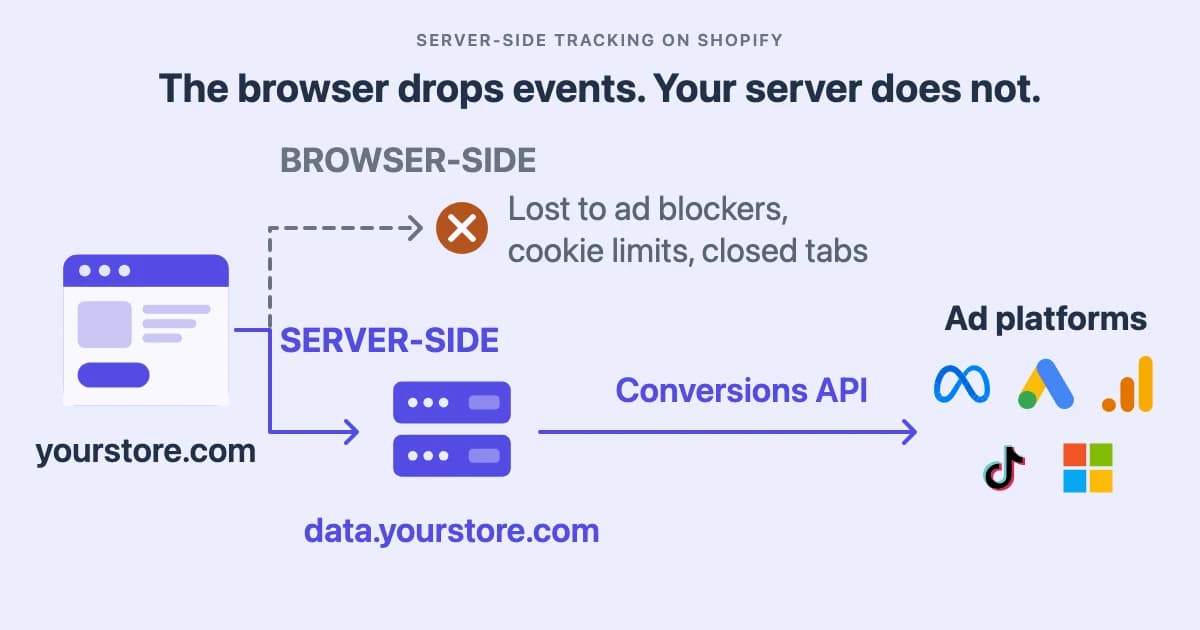
In the first, the browser sends an event to your server, and your server passes it to Meta, Google Ads or TikTok. The data is identical to what the browser would have sent directly. The request now originates from your infrastructure instead of the visitor's device. This is endpoint substitution: a new address on the same envelope.
In the second, the server sends something the browser never knew. The server is not relaying the browser's account of events. It is reporting the business's account of events, which is a different and better source.
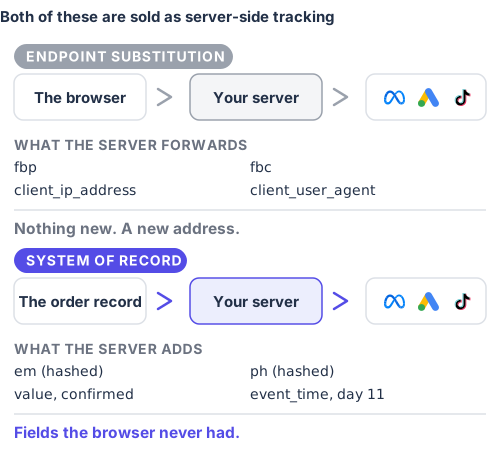
The architecture diagram looks the same for both. The field list is where they separate.
The first is frequently sold as the second. That gap is what the Reddit thread is pointing at, and it is right about the setups it has seen.
What genuinely changes
The events that were being dropped now arrive
Browser-based collection loses events for reasons that have nothing to do with whether the conversion happened.
Safari caps the lifetime of cookies written by JavaScript at seven days, and at 24 hours for a visitor arriving with certain link decorations. Firefox blocks known tracking domains outright through Enhanced Tracking Protection. Ad blockers stop many pixel requests before they fire. Since iOS 14.5, app tracking has required an opt-in prompt that most users decline. A visitor who closes the tab during the redirect back from a payment provider takes the event with them.
Each of these is a reporting failure rather than a business failure. The lead was submitted. The order went through.
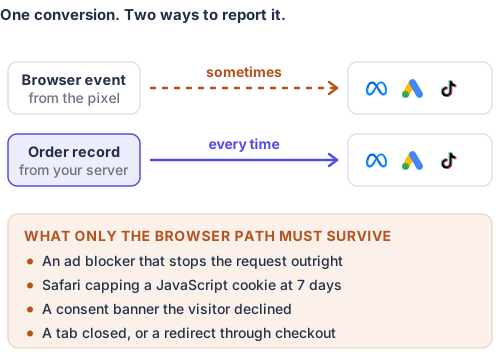
The record on your server passes none of the four, because it was never in the browser to begin with.
The conversion arrives with better identifiers attached
This is the effect that changes campaign performance rather than reporting, and it gets the least attention.
Ad platforms match a conversion to a click using identifiers. Meta uses the fbp and fbc cookie values plus hashed user data. Google Ads uses gclid, or hashed email and phone for enhanced conversions. Microsoft Ads uses msclkid. A browser event carries whatever identifiers survived the browser's own restrictions, which is usually a subset.
A server-side event can carry the record itself. A hashed email address the customer actually typed. A phone number. A value that is correct rather than estimated. A timestamp from the order rather than from a tab that had to stay open.
The optimization signal improves, not just the report
A dashboard that corrects your numbers after the fact changes what you know. Sending better-matched conversions back to the platform changes what the algorithm optimizes toward, because the platform learns from the conversions it can attribute.
Recovered conversions in a report are an accounting improvement. Recovered conversions delivered back to Meta or Google Ads with strong identifiers are a training input. Budget gets spent differently as a result.
What server-side tracking does not change
Is server-side tracking legal?
Moving a request to your own server changes the domain the request goes to. It does not change your obligations under GDPR, ePrivacy or any comparable regime, and it does not create a lawful basis you did not have.
The UK regulator's guidance on storage and access technologies is explicit on this. The rules apply to the act of storing or accessing information on a user's device, whatever technology performs it. If a visitor declined advertising consent, collecting the same data server-side and forwarding it is the thing they declined.
Copy that presents server-side tracking as a way around consent tooling is describing a compliance problem as a feature.
It does not defeat ad blockers as a category
A first-party subdomain is harder to block than a well-known third-party tracking domain, because blocklists are largely domain lists. That is a real and measurable advantage. It is not immunity. Blocklists get updated, subdomains get added to them, and some blocking works on request patterns rather than domains alone.
The visitor's browser also still has to make the initial request to your server. If that first call is blocked, the server never hears about the page view, and no server-side infrastructure recovers it. What the server can still recover is the conversion, because that arrives through your backend rather than through the visitor's browser.
It cannot link a journey with no shared identifier
A visitor clicks an ad on a phone at lunch and converts on a laptop that evening. No cookie spans those two devices. If the conversion carries an email address that matches earlier activity, the two sessions can be linked. If nothing is shared between them, they cannot.
Any tool describing this as solved is describing probability as certainty. Server-side collection improves matching where sufficient first-party identifiers are available, and it has nothing to offer where none are.
It does not make your platforms agree with each other
Reported conversions rise on every platform at once, and each platform still applies its own attribution rules to the events it now receives. The combined total across platforms typically moves further above your real revenue after a good implementation, not closer to it.
That is a measurement improvement being read as a regression, and it is worth understanding before you install anything. The mechanism is in why your ad platform ROAS is wrong.
What is the difference between client-side and server-side tracking?
The two are not alternatives in practice. Almost every working setup runs both, because they fail in different places.
| What you are comparing | Client-side (browser pixel) | Server-side |
|---|---|---|
| Where the request originates | The visitor's device | A server you control |
| Sees on-page behaviour | Yes: scroll, clicks, add-to-cart, page views | Only what is forwarded to it |
| Survives ad blockers | Often not | The conversion path does, if it runs from your backend |
| Survives cookie lifetime limits | Partially, and less over time | Yes, where the record holds its own identifiers |
| Reports an outcome after the session ends | No | Yes, and this is the largest difference |
| Data quality | Whatever the browser retained | Whatever your system of record holds |
| Effort to run | Low | Moderate to high |
The row that matters most is the second to last. A browser cannot report a subscription that reached its second month, or an order taken over the phone and entered in your admin. Those outcomes happen after the browser has gone.
Which server-side tracking setup is best for you?
"Server-side tracking" covers four arrangements that behave differently, and the difference is not cosmetic.
| Architecture | What it reaches | What it does not reach | Choose it when |
|---|---|---|---|
| Server-side GTM container | Browser events, routed from your own subdomain | Anything your backend knows and the browser did not | You need first-party delivery and routing, and you accept that it is endpoint substitution unless you feed it |
| Vendor-hosted collector | The same, without you running the infrastructure | The same gap, unless the collector is also fed from your backend | You want the routing layer and do not want to operate it |
| Direct server-to-server | Your own business events, with the record's identifiers attached | On-page behaviour: scroll, add-to-cart, anything before the conversion | The outcome you care about is first recorded in your store backend |
| Managed, with TrueTracked | The same, with collection, session linking and delivery already connected | Anything your systems never recorded, and Google Ads as a payload it builds itself | You want the pieces joined up rather than assembled |
What is server-side tracking in Google Tag Manager?
In Google Tag Manager it is properly called server-side tagging, and the wording is deliberate. You run a server container on a subdomain of your own site. The browser sends events to it, and the container distributes them to destinations.
Google's own introduction to server-side tagging is careful about that distinction, and it is the honest one. A container is a routing layer. Unless you feed it from somewhere other than the browser, it forwards what the browser already sent.
These are not mutually exclusive, and most mature setups run more than one.
What it actually recovers, in one month
The month below is a composite, built from a store running Meta and Google Ads. The amounts are constructed. The arithmetic is the point, and it is the arithmetic that repeats wherever the conversion is recorded somewhere other than the browser.
| What happened | Where it is recorded | Reached Meta from the browser | Reached Meta from the server |
|---|---|---|---|
| 412 orders | Your store admin | 291 | 379 |
| 47 subscription renewals, 30 to 60 days later | Your store admin | 0 | 47 |
| Delivery rate on orders | 71% | 92% |
Two separate stories sit in that table and they are usually told as one.
The first row is resilience. The browser path delivered 291 of the 412 orders that actually happened, and the server path delivered 379. The 88 recovered orders are what people mean by "server-side recovers lost conversions", and the gain is real but bounded.
The second row is the one that changes what the platform optimizes toward. Forty-seven of those customers renewed a subscription, 30 to 60 days after the original click, with no visit attached. No browser was ever going to report a single one of them. They reach Meta or Google Ads only as a server-side event, sent when the renewal is recorded, matched back to the original click on an identifier captured at checkout.
A lead generation advertiser reads the same table with form submissions in the first row and closed deals in the second. The conversion object changes. The arithmetic does not.
The failure that quietly doubles your numbers
Both the browser pixel and the server-side event fire for the same conversion. The platform has to recognise them as one, and it does that by matching an event ID.
Meta's deduplication documentation specifies that the pixel's eventID must match the server event's event_id, and that the pixel's event must match the server's event_name. It adds a constraint most implementations miss: events are deduplicated only if they arrive within 48 hours of the first event carrying that ID. A nightly batch that runs three days late will not deduplicate, however correct its IDs are.
Two ways this goes wrong in practice.
The first is generating the ID separately on each side, for instance a timestamp in the browser and a database row ID on the server. They will never match, and every conversion counts twice.
The second is subtler: running two attribution vendors that both send conversions to the same platform. Each vendor generates its own event IDs. The platform has no basis to connect them. You will double-count every conversion for as long as both run, and the reports will look like the new tool is working extremely well. If you are migrating between tools, send from one at a time.
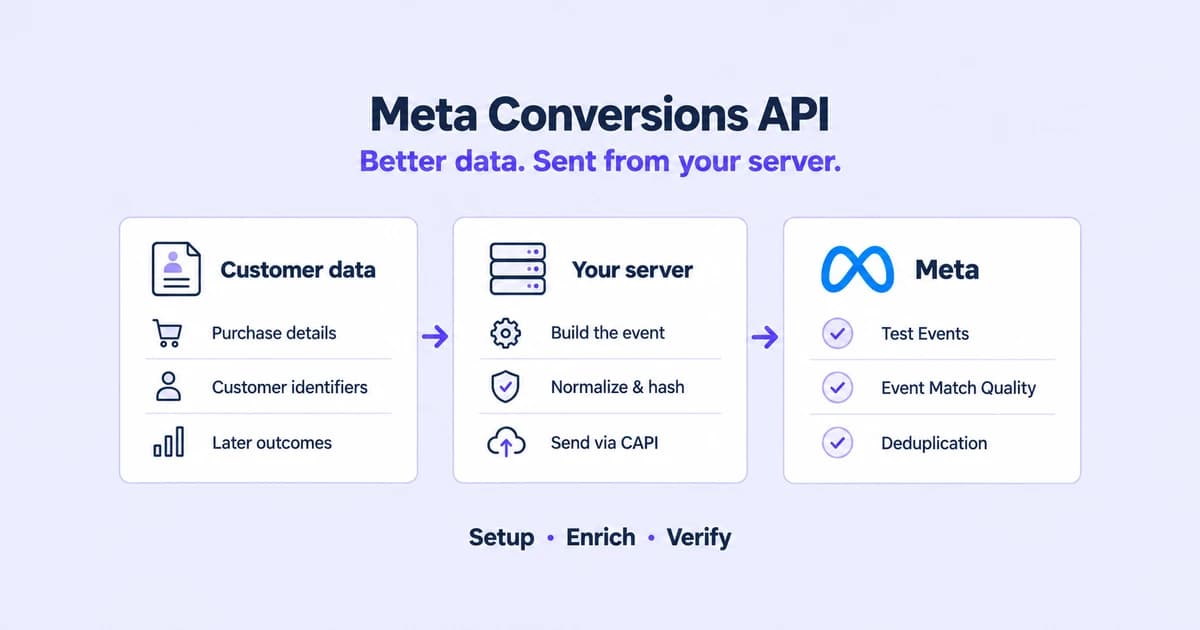
The payload, the hashing rules and the verification steps are in the Meta Conversions API guide.
Four checks to tell which setup you have
In order of how much they tell you.
- Name the field. Ask what a server-side event contains that the corresponding browser event does not. If nobody can name one, the setup is endpoint substitution regardless of the architecture diagram.
- Check the match quality. Meta reports an Event Match Quality score per event type in Events Manager. Compare browser events against server events. If the server events do not score higher, they are not carrying more identifiers.
- Break the browser deliberately. Complete a test conversion with an ad blocker enabled, or with the pixel domain blocked in your hosts file. If the conversion still reaches the platform, your server is genuinely independent of the browser. If it does not, your server-side path depends on a browser call that can be blocked.
- Compare against your own records. Count orders in your store admin for a fixed period, and compare against each platform's figure for the same period. Platform totals will exceed your own once added together, because each platform claims what it can see. What matters is the direction of the gap for each individual platform, tracked over time.
The fourth is the one worth repeating monthly, because it is the only one that measures the outcome rather than the plumbing.
What it costs to run
Three costs, and the first is the only one most people budget for.
Infrastructure. A server-side container on Google Cloud, or a hosted equivalent. Pricing depends on request volume and on who runs it, and it moves often enough that any figure quoted here would be stale before you read it. Check the provider's current pricing page rather than a blog post, this one included.
A subdomain and its certificate. The collector runs on something like data.yoursite.com. That is a DNS record and a TLS certificate, and it is the part that makes requests first-party from the browser's point of view.
Ongoing verification. Platforms change API versions. A required parameter becomes optional, or an optional one becomes required. A checkout is redesigned and the event feeding the server stops firing. None of this announces itself, because a server-side setup fails quietly: the requests keep succeeding and simply carry less.
That third cost is why "set it up once" is the wrong mental model. The setup is a week. The verification is permanent.
How TrueTracked does this
TrueTracked records the conversion from your own systems and sends it onward with the identifiers already attached, rather than relaying what the browser managed to hold on to.
Events go to Meta through the Conversions API and to TikTok through the Events API. Both carry an event ID shared with the browser pixel, so the platform deduplicates rather than double-counts. Purchases go to GA4 through the Measurement Protocol. Microsoft Ads receives orders through offline conversion import, in batches. The msclkid is resolved from up to 90 days of session history. That is the path carrying an order recorded in your admin rather than in a browser back to the platform that earned it. Google Ads conversions ride a server-side container rather than a payload TrueTracked builds itself, which is a real difference and worth naming rather than blurring into the list.
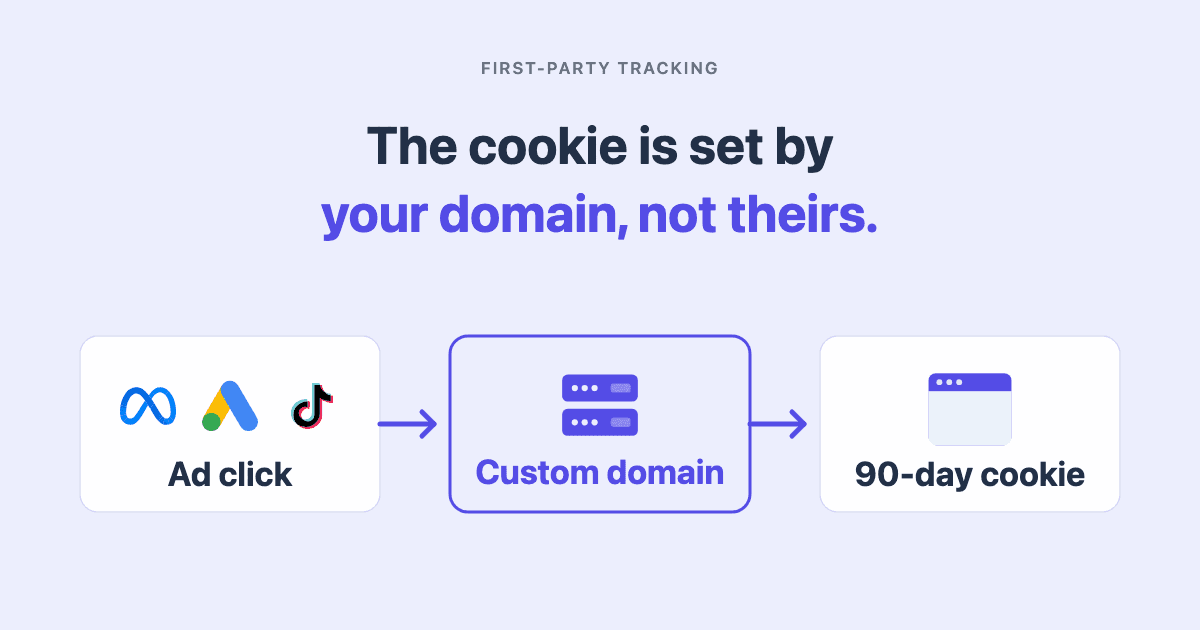
Two settings do the connecting work and they are easily confused. With a verified custom tracking domain, TrueTracked sets _fbp and _fbc through server response headers, requests a 90-day lifetime, and refreshes valid values on later visits. Separately, when a purchase arrives, the enrichment lookup searches up to 30 days of linked sessions for stored click context. The custom domain gates the cookie sync only. Conversion delivery runs without it.
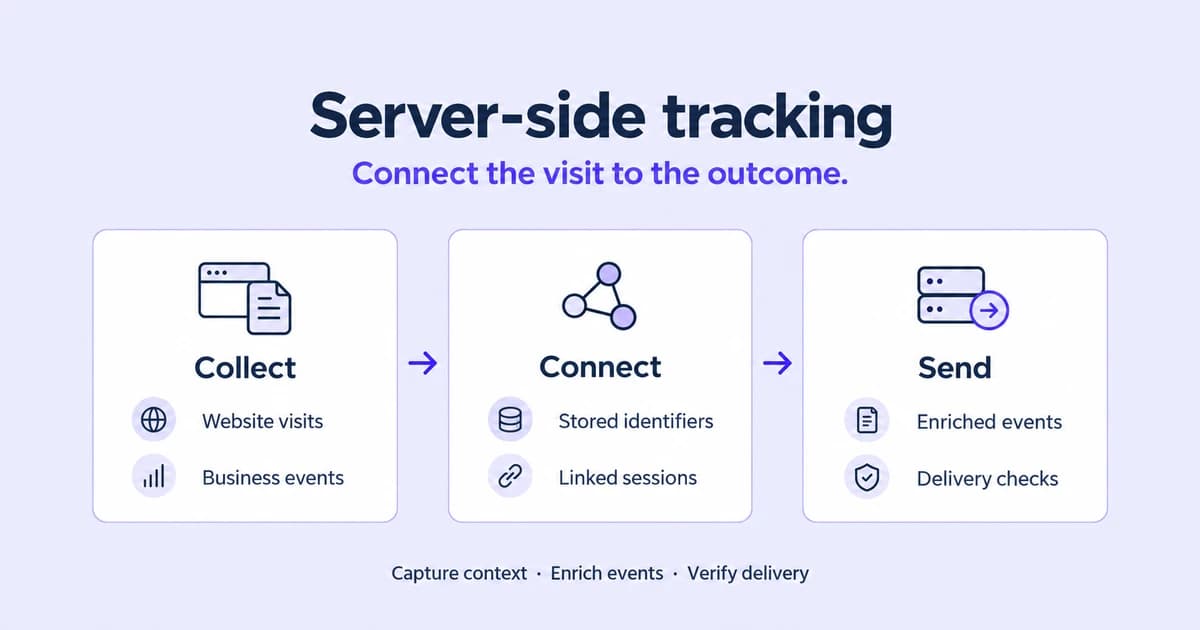
Where the record carries an email address, a phone number or a customer ID, those sessions are linked into one journey. Where a visit shares no identifier with any other, it is not linked, and no configuration changes that.
If you want to see the shape of it, TrueSignal is the page to start on, and first-party tracking covers the data classification underneath it.
Where this leaves you
Server-side tracking is worth doing, for a narrower and more specific reason than it is usually sold on. It is worth doing when your server holds information the browser cannot see: a confirmed payment, a customer record, an outcome recorded after the session ended.
Where it forwards the browser's own account of events to a new address, it buys resilience against blocking and little else, and it should be priced and described that way.
The sequence that avoids the common failures:
- Decide what the conversion actually is for your business, and where that fact is first recorded. That system is the source, not the browser.
- Capture the conversion server-side from that system, with the identifiers already attached to the record.
- Send it with a shared
event_idmatching the browser event, inside the 48-hour window, and verify deduplication in the platform's own interface before trusting the numbers. - Compare against your own records monthly, per platform, and watch the direction of the gap.
Sources
- Is it just me, or is server-side tracking being sold like snake oil, r/GoogleTagManager, for the endpoint-substitution criticism and its position on the SERP
- An introduction to server-side tagging, Google Tag Manager developer documentation, for the server container architecture and the tagging-versus-tracking distinction
- Full third-party cookie blocking and more, WebKit, for Safari's seven-day cap on cookies written by JavaScript
- Enhanced Tracking Protection in Firefox for desktop, Mozilla Support, for domain-list blocking of known trackers
- App Tracking Transparency, Apple Developer Documentation, for the opt-in prompt required since iOS 14.5
- Handling duplicate pixel and Conversions API events, Meta for Developers, for the
event_idandevent_namematching rule and the 48-hour deduplication window - About enhanced conversions, Google Ads Help, for hashed email and phone as click-matching identifiers
- Guidance on the use of storage and access technologies, Information Commissioner's Office, for the rules applying to the act rather than the technology
- Measurement Protocol for Google Analytics 4, Google Analytics developer documentation, for server-side event delivery to GA4
All nine sources checked September 2026.
Frequently asked questions
About the author

Founder of TrueTracked · Tracking, Attribution and Paid Ads Specialist
Seven years implementing conversion tracking and attribution for businesses running paid ads, most of it fixing measurement that was already broken.